Freezer ice makers and standalone units
Sub-Zero ice maker repair, traced back to its source
An ice maker stands at the very end of a queue. It can only freeze what the supply line delivers, and only when the freezer around it is holding proper cold. That is why an empty bin is often a message about water or about the freezer rather than about the ice maker. We check all three links in order, and the visit costs $89.
4.8 of 5 tallied across 187 reviews Where the score comes from
Inside the freezer or a unit of its own
Sub-Zero ice comes from two kinds of equipment. Which one you own, if your model has one at all, decides where the first checks go.
Specimen A
Ice maker inside the freezer
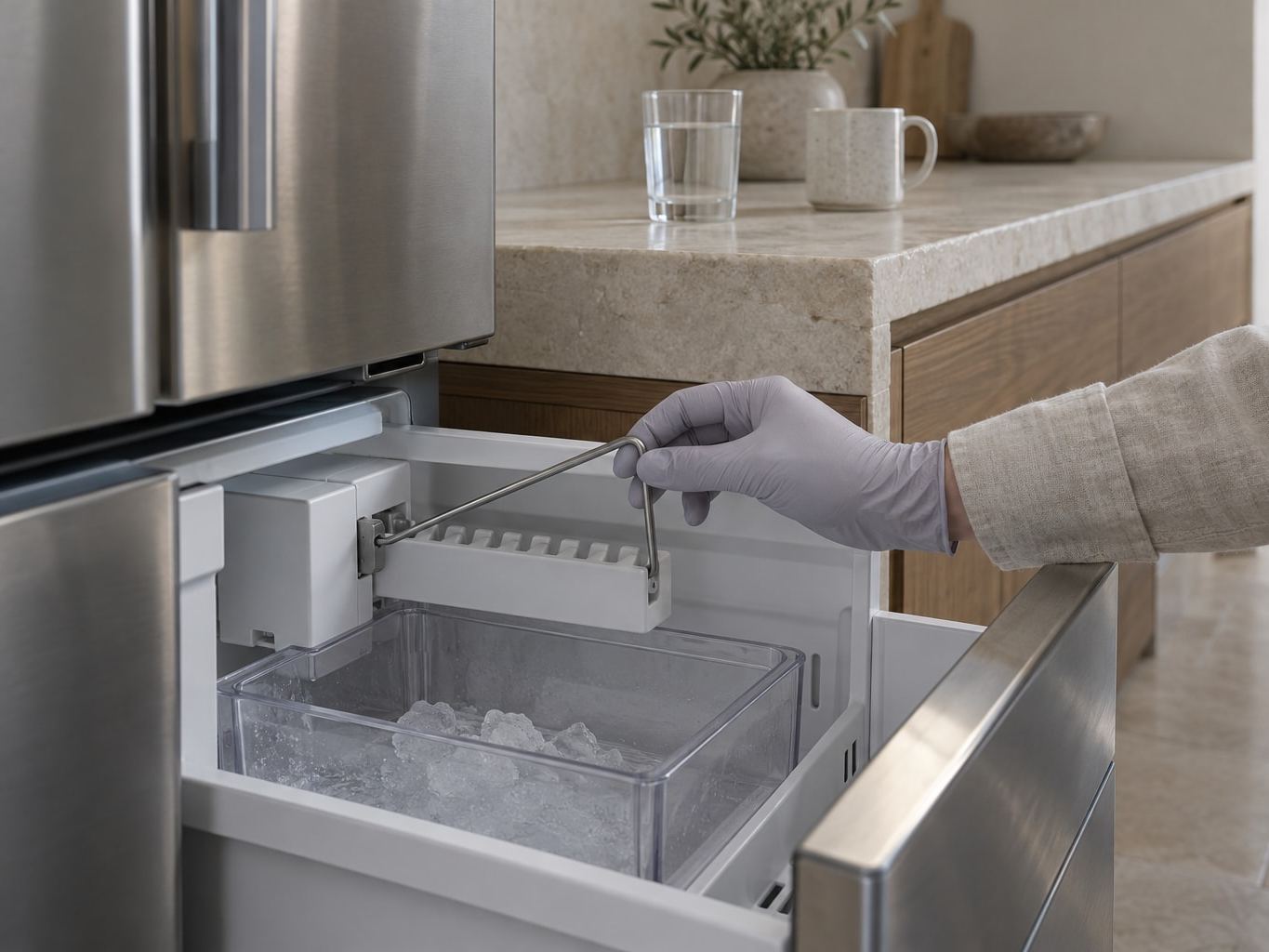
- Sits in the freezer compartment of a column or combination model, feeding a bin or drawer
- Borrows its cold entirely from the freezer, so any freezer weakness shows up as slow or missing ice
- Usually has an on/off control or switch, sometimes overlooked after cleaning
- Water arrives through a valve and a fill tube that can freeze shut
Specimen B
Standalone undercounter ice maker
- A dedicated appliance under the counter, commonly tucked into a bar counter or pantry run
- Has its own refrigeration system, so the freezer elsewhere in the kitchen is irrelevant
- Needs a drain or pump for meltwater, which adds a possible point of failure
- Mineral scale and dirty surfaces affect production and clarity
Either way, the three questions are the same: is water arriving, is the cold sufficient, and is the mechanism completing its cycle?
What the ice tells you
Each sign below is grouped by its most likely source: water, cold or the mechanism.
-
An empty bin and silence where the fill should gurgle
Water: the stop under the sink closed, sediment choking the filter, an inlet valve that no longer opens, or ice plugging the fill tube
-
Small, hollow or crescent-thin cubes
Water: too little arriving per cycle because of low pressure, a restricted filter or a partially open valve
-
Ice production slowly falling over weeks
Cold: the surrounding freezer slipping warmer, typically from lint on the condenser or a fan losing speed
go to the repair -
The whole bin welded into one lump
Cold: swings that soften the surface and refreeze it, or a bin nobody has scooped from in weeks
-
Cloudy, white or bad-tasting ice
Water: an overdue filter, minerals in the supply, or stale ice absorbing freezer odours
-
Water dripping into the bin or ice forming on the tray
Mechanism or water: an inlet valve that weeps after closing, or a module that fills but never finishes ejecting
-
Loud grinding, clicking or a cycle that stops halfway
Mechanism: a worn motor, a jammed ejector, or cubes caught in the mechanism
Water, cold and the mechanism, checked in that order
Water comes first because it fails most often and is the cheapest to rule out. The line begins at a small stop beneath the sink or tucked behind the cabinet, runs through a filter cartridge on models that carry one, and ends at a solenoid inlet valve that opens briefly to meter each fill. Weak household pressure, a cartridge packed with grit, a stop nudged half closed by a plumber working nearby, or a fill tube glazed with ice will each starve the mould. The ice that results is small, hollow or missing.
Cold comes second. A freezer-mounted ice maker owns no refrigeration; it waits for the freezer to bring the mould cold enough before releasing the cubes. Let that compartment drift warm and output drops and the cubes may come out soft at the core or stick together. This is where an ice complaint quietly becomes a freezer repair, and why our technicians read the freezer temperature before touching the ice maker.
Only then does attention turn to the mechanism: the motor, the ejector, the heater that releases the cubes, the sensor or arm that detects a full bin, and the board sequencing each cycle. For a standalone undercounter ice maker, the list also includes its own refrigeration, the drain and any pump. Entertaining puts these machines under real pressure; our note on hosting a crowd covers how to prepare.
Checks you can make yourself
Working through these occasionally solves things outright; otherwise it narrows the field before we arrive.
-
Make sure production is enabled
Depending on the model, ice production is toggled on the display or by a small switch near the mould. A wipe-down or a curious child can turn it off unnoticed.
-
Look at the bin and its sensor
If the bin is full or pushed back incorrectly, or a cube is resting on the sensor or arm, the ice maker thinks it has done its job. Seat the bin properly and clear any jam.
-
Check the filter
Models with a cartridge rely on it staying clear. If yours is past due, swap it following the manual. A clogged cartridge is a classic reason for sluggish or undersized ice.
-
Find the supply valve
Trace the thin supply line back to its stop and turn the handle fully open, particularly if anyone has worked on the plumbing lately.
-
Be patient after a fix
Following a cartridge swap or restart, early harvests often come out undersized or oddly shaped. Toss those and judge by later ones.
Why is my Sub-Zero ice maker not making ice?
Rule out the easy ones: production switched off at the control, a bin seated wrong or a cube sitting on the full sensor, a closed supply stop, or a filter long past its change. Beyond those, expect a tired inlet valve, an iced fill tube, a freezer that has lost its edge, or a worn-out module.
Why is my Sub-Zero ice maker so slow?
Sluggish output nearly always traces to a thinner fill or weaker cold. Grit in the cartridge, low pressure or a half-open stop shrinks each fill; a freezer sitting too warm lengthens every freeze. Change a stale cartridge, put a thermometer in the freezer, and book a diagnosis if nothing improves.
When water reaches the floor
Ice maker questions
- Ought the ice maker to be turned off while we are away or the water is off?
- Yes. An ice maker that keeps calling for water it cannot get may cycle needlessly, and an unattended house lets a minor weep become a soaked floor. Switch it off from its control, scoop the bin out before extended trips, and turn it back on when the water supply is restored.
- Ice has stopped, yet the freezer still feels properly cold. What now?
- A cold freezer moves suspicion to water and mechanics: ice inside the fill tube, an inlet valve gone dead, a full-bin sensor stuck reporting full, or a module that has stopped stepping through its cycle. A technician can test each part directly.
- What gives my ice an odd taste or smell?
- Ice absorbs odours from the freezer and from the water supply. Usual sources are a cartridge overdue for change, ice that has sat for weeks, or uncovered food sharing the freezer. Empty the bin, replace the filter if due, and the next batches should taste clean.
- Is a leaking ice maker dangerous?
- The leak itself is mainly a risk to floors and cabinetry, but water near outlets and wiring needs care. Follow the safety note above, close the stop while standing somewhere dry, and get the source traced; the inlet valve and fill connection are frequent offenders.
- If the freezer is really to blame, does the same $89 visit cover it?
- It does. We charge for the trip rather than for each machine, so once the technician finds that the freezer is behind the empty bin, diagnosing it adds no second call-out. Approve the work and the $89 is folded into the repair. See pricing and refrigerator repair covers the rest of the cold family.
- Do you repair ice makers in my area?
- Yes, in each of the eleven places we cover: Pacific Palisades, Castellammare, the Riviera, Topanga, Malibu, Santa Monica, Brentwood, Mar Vista, Westwood, Century City and Beverly Hills. Wine units are on wine storage repair.
Why are my ice cubes small and hollow?
Thin or hollow cubes mean the mould is going short of water at each fill. Grit in the cartridge, weak household pressure, a stop left partly closed, or an inlet valve beginning to stick are the habitual causes. Start with a fresh cartridge; persistent small cubes call for a pressure and valve test.
Get the ice flowing again
Ring whenever it suits, day or night, for the soonest opening. If you have already tried the checks above, tell us what you found. Our contact page lists everything else.
$89 per visit, billed once for each trip to your home, even when the technician opens up several cold units on that trip; every cent of it is subtracted from the final invoice once you approve the fix.