Columns and below-counter wine cabinets
When a Sub-Zero wine column stops holding its temperature
A wine unit makes three quiet promises to the bottles inside it: an unchanging temperature, protection from light, and stillness. When one of those promises breaks, the wine pays slowly and invisibly. Our technicians work out which promise has failed, why, and what it will take to keep it again, and the whole visit is billed at $89.
4.8 of 5 tallied across 187 reviews Where the score comes from
The first promise: temperature that holds, air that is not too dry
Wine forgives a slightly warm cellar; what it never forgives is restlessness. A bottle kept slightly warm but steady ages more gracefully than one that rises and falls a few degrees every afternoon, because each swing pushes the liquid against the cork and draws air back as it contracts. Sub-Zero designs its wine cabinets, tall and below-counter alike, to stop that breathing. Its sensors read each zone, its control calls for cooling in small doses, and its fans spread the cold keeping the highest and lowest racks close to one another.
Humidity is the quieter partner of temperature. Air that becomes very dry over months can shrink natural corks and let oxygen in, while condensation that pools inside the cabinet invites mould on labels. A closed, well-sealed wine cabinet holds its moisture far better than an open room, which is why a leaky gasket or a door resting a hair open matters more here than it would in a kitchen refrigerator.
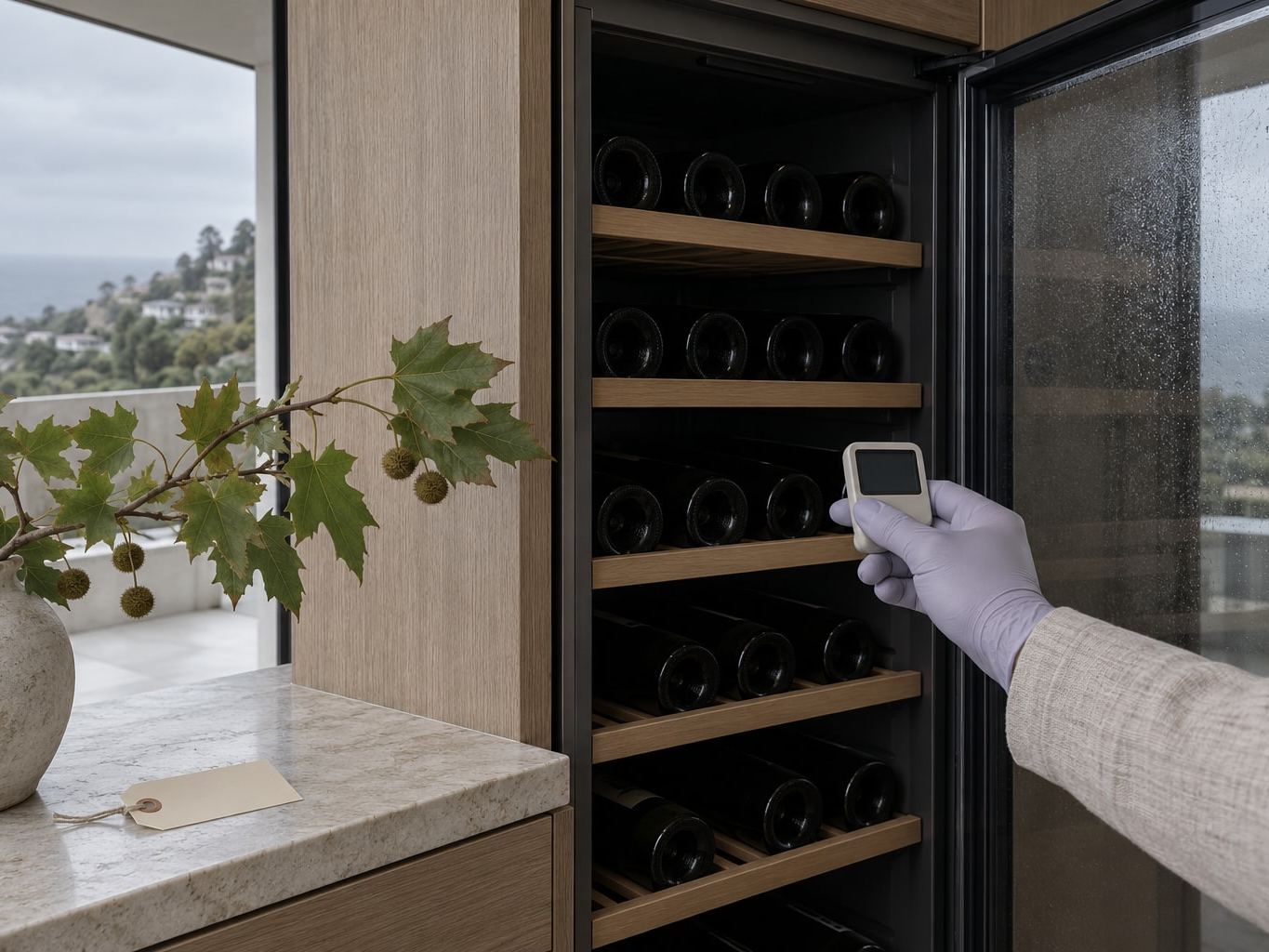
When the display and the wine disagree, believe the wine and a second thermometer. A drifting sensor may display the correct number while the zone sits warmer, and a fan that has slowed can leave the upper racks noticeably warmer than the lower ones even when the average looks right.
Why is my Sub-Zero wine cooler not cooling?
Look first at the grille, where lint or a stack of cases can choke the condenser, then at fans that have lost speed, a gasket that has given up gripping, and a sensor or board reading wrong. Sealed-system failures turn up less often. An independent thermometer reading helps us confirm which one.
Three promises and what breaks each one
Most wine unit complaints fit neatly into one of three groups. Knowing the group points to the check worth doing first.
| Promise | What breaks it | What to check first |
|---|---|---|
| Constancy of temperature | Sensors wandering, fans losing pace, lint on the condenser, a leaky door edge, a tired compressor or board | A second thermometer in the affected zone, the grille, the door closing on its own |
| Darkness | Interior lighting left on or stuck on, a failed door switch, direct sun on the glass | Whether the light goes out when the door closes, where the sun falls during the day |
| Quiet and stillness | Worn fan motors, a loose shelf or panel, a cabinet sitting off-level, compressor mounting problems | Rattling when a rack is touched, the unit resting firmly on all its feet, changes in sound over time |
Symptoms bottle owners notice
-
The display shows the setting, but the bottles feel warm to the touch
A misreporting sensor, or a zone whose air has stopped circulating well; compare against a second thermometer
go to the note -
Two zones that should differ read almost the same
A divider seal, a zone damper or fan, or the control logic separating them
-
Mist forming behind the glass door
Moist room air creeping around the gasket, or a door that bounces back a little open after restocking
-
A drone that gets louder week by week
A fan motor nearing the end of its bearings, or a compressor straining beyond its normal load
-
A rattle when the compressor starts
A loose panel, a shelf not seated, or feet that have shifted so the cabinet rocks
-
Interior lighting glowing after the door closes
A door switch or lighting control fault, which also adds a little heat to the cabinet
-
A small pool forming on the floor below the door
A blocked drain or condensate overflowing, sometimes from a door that has been sealing poorly for a while
Why does my Sub-Zero wine storage temperature keep fluctuating?
Swings usually come from the door, the air or the sensor: a gasket admitting room air, frequent openings during a party, bottles crammed so close that circulation stalls, a slowing fan or a drifting sensor. A steady display with swinging bottle temperatures points to the sensor or airflow rather than the compressor.
Measure it yourself before calling
This simple test separates a real fault from a display that is just being misread.
- Stand a trustworthy thermometer probe inside a small bottle of water on the zone's centre rack
- Shut the door and resist opening it for two hours or more
- Read the thermometer before opening the door wide, ideally through the glass
- Repeat in each zone if your unit has more than one
- Write down the probe value, what the display claims and the hour
- Confirm the grille is unobstructed and that the door swings shut by itself
- Tell us the readings when you call; they help us arrive thinking about the right cause
Can a Sub-Zero wine fridge be repaired or should I replace it?
In most cases it can be repaired. Fans, sensors, controls, gaskets and lighting are replaceable parts, and even sealed system work is possible. A diagnosis gives you the actual fault and the repair price, so the replace-or-repair decision is based on numbers rather than a guess.
The first day after switching on or moving the unit
Many calls come right after a new installation, a move or a long power cut. Some behaviour in this window is normal.
-
Switching on
The compressor and fans run hard, and the display may not yet match the setting. This is the unit pulling the cabinet down to temperature.
-
Loading
Warm bottles added in bulk slow the pull-down considerably. Adding them in batches lets the unit recover between loads.
-
Settling
Running becomes intermittent as zones reach their settings. Small differences between upper and lower racks narrow.
-
End of the first day
A unit that still cannot reach its settings, runs constantly or shows zones that refuse to separate is worth a service visit rather than more waiting.
Misreadings we often correct
-
MisidentifiedA wine unit is basically a small refrigerator, so it needs the same repair.
Det.Wine cabinets are engineered for softer, steadier cooling, humidity control and low vibration. Its controls, zones and air circulation are different, and diagnosing it as a kitchen refrigerator misses the point. Our refrigerator repair page covers the fresh-food side.
-
MisidentifiedIf it is cold enough, the wine is fine.
Det.Wine suffers more from movement and swings than from a degree or two of steady difference. A unit that cycles widely around the right average can still harm the bottles.
One zone or several
Sub-Zero wine storage comes in single-zone and multi-zone configurations, and that difference changes where trouble usually hides.
Specimen A
Single zone
- One temperature throughout the cabinet
- Fewer sensors and dampers, so faults are usually in the fan, condenser, seal or control
- Uneven temperatures from top to bottom point mainly to airflow
Specimen B
Two or more zones
- Separate settings for different wines or for serving and storage
- Every zone relies on a sensor and an air path of its own, and the divider between them needs a good seal
- Zones reading the same value usually points to a divider, damper, fan or control problem
Whichever you have, testing each zone with a separate thermometer before the visit makes the diagnosis faster and more certain.
Wine storage questions
- Is a broken wine fridge fixable, or is replacement smarter?
- A built-in Sub-Zero wine unit is usually worth diagnosing before deciding. Fans, sensors, controls, seals and lighting parts can all be replaced. A sealed system failure is a bigger repair, and once you know the actual fault and its price, you can compare it with replacement on real numbers. Our pricing page shows what goes into a repair figure.
- Where should the bottles go while the cabinet is out of action?
- Keep the bottles somewhere cool, dark and stable, away from kitchen heat and sunlight, and lying on their sides if they have natural corks. A short spell out of the unit in a cool interior room does far less harm than a cabinet swinging up and down.
- Does the $89 visit charge cover several units?
- Yes. We bill the trip rather than each machine, so having a refrigerator, a freezer or an ice maker examined on the same visit changes nothing. Approve the repair and that $89 is folded into it. For freezer issues see freezer repair.
- Do you service wine units across the coast and the Westside?
- Yes: Pacific Palisades, Castellammare, the Riviera, Topanga, Malibu, Santa Monica, Brentwood, Mar Vista, Westwood, Century City and Beverly Hills.
Have your wine unit checked
Phone at any hour for the soonest opening. Already run the thermometer test? Bring those numbers to the call. Everything else about reaching us lives on the contact page.
$89 per visit, billed once for each trip to your home, even when the technician opens up several cold units on that trip; every cent of it is subtracted from the final invoice once you approve the fix.